
If you’ve ever asked “where is the catalytic converter located on my car?” you’re not alone in your curiosity. Knowing the catalytic converter location helps you with basic maintenance, quick inspections, and even theft prevention. This guide explains exactly where to find a catalytic converter on a vehicle, how to spot it safely, and what to look for on different engine types (sedans, SUVs, trucks, hybrids, and diesels). I’ll keep the language simple and practical so even first-time car owners can follow along with confidence.
Where the Catalytic Converter Sits
-
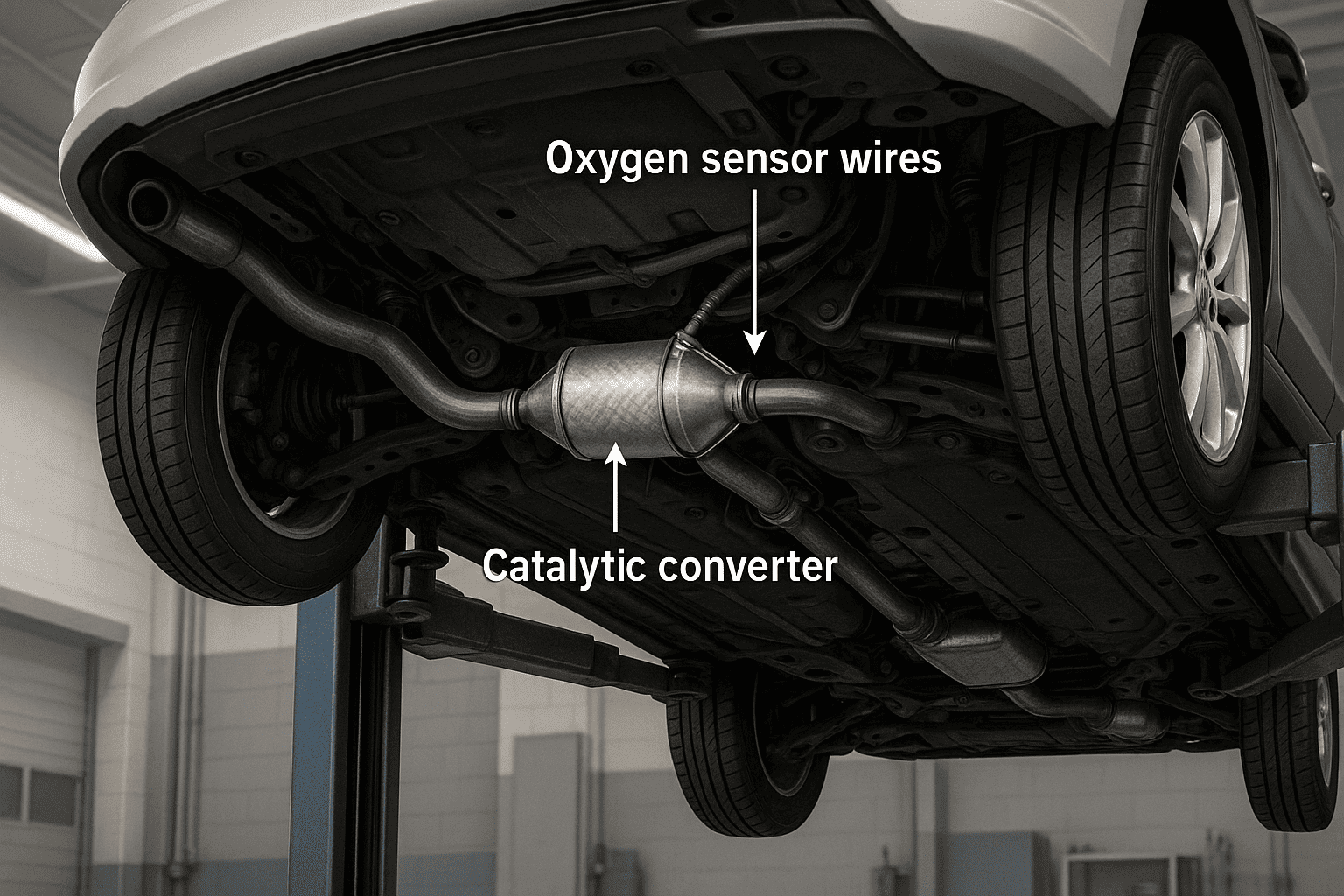
General rule: The catalytic converter sits in the exhaust system between the exhaust manifold (at the engine) and the muffler/tailpipe (at the rear).
-
Most gasoline cars: You’ll find at least one close to the engine (to heat up fast) and often a second under the floor, roughly around the middle of the car.
-
Trucks & SUVs (V6/V8): Often two small “manifold” cats near the engine (one per bank) and sometimes an additional underfloor main cat.
-
Diesels: You’ll see a catalytic converter combined with DPF (diesel particulate filter) and sometimes SCR systems, usually under the vehicle near the middle/front section.
-
EVs: Pure electric cars do not have catalytic converters because there’s no exhaust.
Why You Should Know the Location
-
Maintenance checks: Spot leaks, damaged heat shields, or loose hangers.
-
Repair clarity: If a shop mentions a cat or O2 sensors (oxygen sensors), you’ll understand where they are.
-
Theft prevention: Catalytic converter theft is still a problem. Knowing the catalytic converter position helps you protect it.
Quick Primer: How Exhaust Flows (So Location Makes Sense)
From Engine to Tailpipe
-
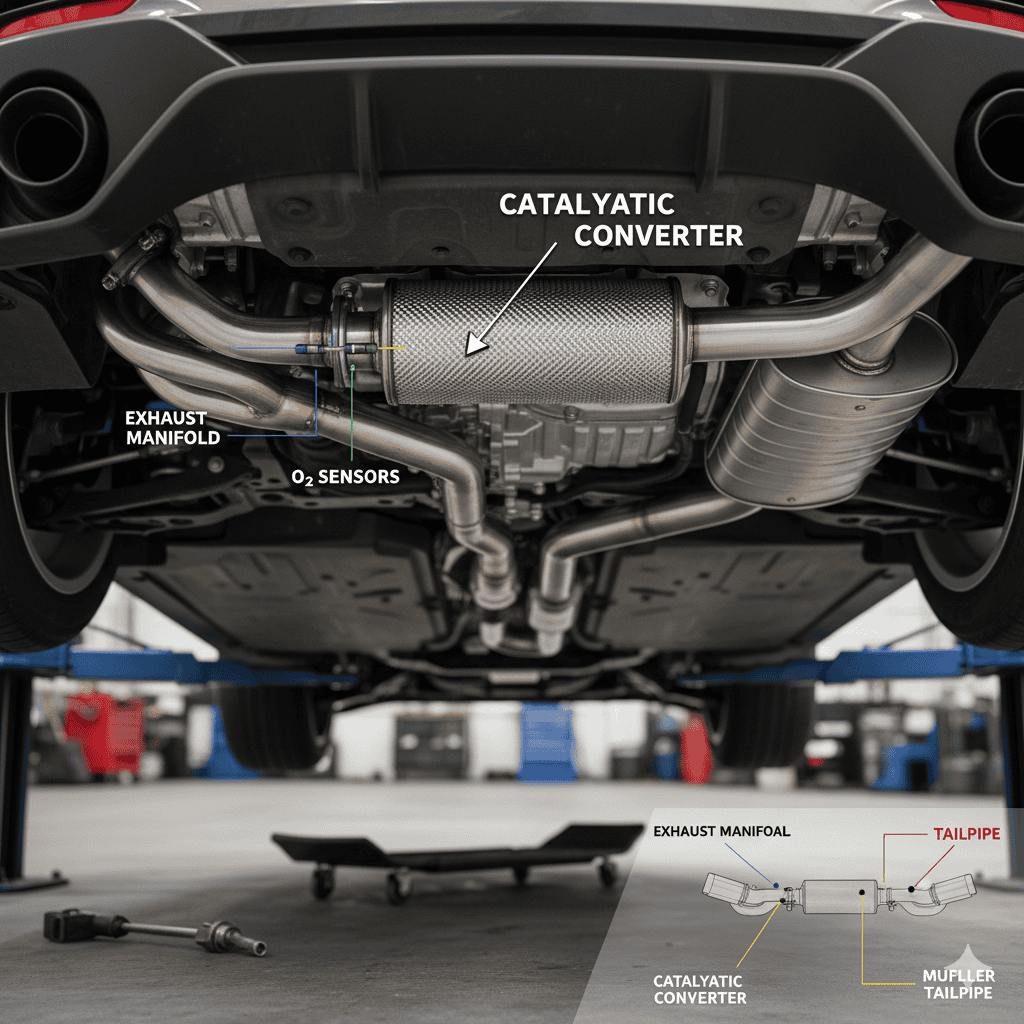
Engine & exhaust manifold: Exhaust leaves the cylinders and collects in the manifold.
-
Catalytic converter: Sits after the manifold, where it converts harmful gases (HC, CO, NOx) into less harmful ones.
-
Resonator (if fitted): Tunes sound; not always present.
-
Muffler: Quietens exhaust noise.
-
Tailpipe: Sends gases out the back or side.
What the Catalytic Converter Looks Like
-
A metal canister (oval or round), larger than the pipe attached to it.
-
Often covered by a heat shield.
-
You’ll typically see O2 sensor wires before and after it (small sensors screwed into the pipe with wires leading to the engine harness).
Where You’ll Find a Catalytic Converter by Vehicle Type
1) Front-Engine Gasoline Sedans & Hatchbacks (Most Common)
-
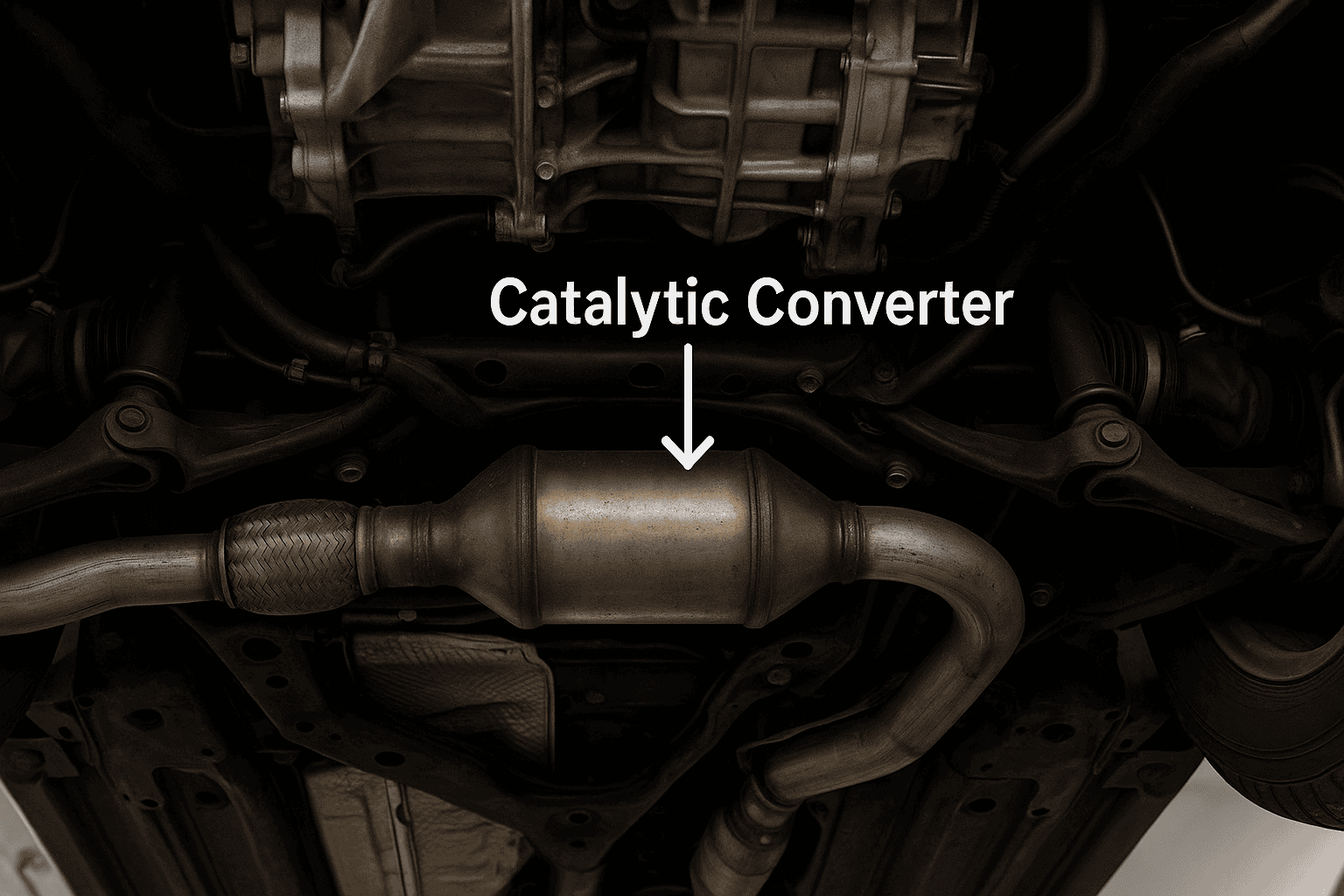
Primary cat placement: Very close to the engine, sometimes integrated with the exhaust manifold (“manifold cat” or “close-coupled cat”).
-
Secondary cat (if fitted): Under the floor, roughly mid-car, before the resonator/muffler.
-
How to check: Look through the engine bay near the back of the engine (for transverse engines, that’s the firewall side), or slide a safe mirror under the car and look near the front subframe moving rearward.
2) Trucks and Body-on-Frame SUVs
-
V6/V8 engines: Expect two smaller converters near the engine—one per bank—right after each exhaust manifold.
-
There may be a larger underfloor main catalytic converter further back in the system.
-
Ground clearance makes them easier to see, but still use jack stands if you’re going underneath.
3) V6/V8 Performance Cars (Dual Exhaust)
-
Similar to trucks: two “bank” converters up front, potentially followed by one or two underfloor cats depending on the design.
-
Don’t confuse the resonators in a dual setup with converters; resonators are usually farther back and not shielded like cats.
4) Turbocharged Cars
-
The turbo sits at the manifold, and the catalytic converter is often right after the turbo (close-coupled to keep it hot).
-
You’ll usually find the cat in the downpipe, very close to the engine/turbo area, then possibly an underfloor cat further back.
5) Hybrids
-
Hybrids still use gasoline engines, so catalytic converter location is similar to non-hybrids: one close to the engine, possibly a second underfloor.
-
Because many hybrids run the engine intermittently, warm-up efficiency is important—another reason cats stay near the engine.
6) Diesels (DPF, SCR, DOC)
-
Modern diesels typically combine a diesel oxidation catalyst (DOC) with a DPF and sometimes SCR (for NOx control).
-
These units are generally under the car, ahead of the middle section, protected by shields and mounted in a single or multi-canister assembly.
-
If you see a large canister with temperature sensors, pressure lines, or an injector (DEF/AdBlue) nearby, you’re likely looking at the diesel after-treatment package.
7) Electric Vehicles
-
No catalytic converter. If there’s no tailpipe, there’s no exhaust and no cat.
Step-by-Step: How to Find Your Catalytic Converter Safely
Safety first: Never crawl under a car that’s only supported by a jack. Use jack stands on solid ground. Wear gloves and eye protection. Exhaust parts can be very hot after driving—wait until they cool.
-
Park and secure the vehicle. Flat surface, parking brake on.
-
Let the exhaust cool. Touch only when it’s safe.
-
Identify the tailpipe and muffler at the rear. Work your way forward along the exhaust.
-
Locate the resonator (if present). This is a straight-through silencer—not the cat.
-
Find the catalytic converter canister(s). Look for a larger, heat-shielded can in the exhaust stream with O2 sensors before and after it.
-
Trace forward to the front of the car. On many cars you’ll see an underfloor cat plus a close-coupled/manifold cat near the engine or turbo.
-
Confirm with O2 sensors. The cat typically has an upstream and a downstream oxygen sensor. Seeing sensor wires is a strong clue you’ve got the right component.
-
Avoid removing shields or sensors. If anything looks loose, rattling, or leaking, note it and speak with a professional.
How to Tell It’s the Converter (Not the Muffler or Resonator)
-
Catalytic converter:
-
Metal canister with heat shields; placed between manifold and muffler.
-
O2 sensors often installed before and after.
-
Usually smaller than a muffler but larger than straight pipe.
-
-
Muffler:
-
The largest box at the rear of the car.
-
Designed to quiet the exhaust; no O2 sensors attached directly to it.
-
-
Resonator:
-
Medium-sized, usually before the muffler.
-
Helps tune sound; typically no O2 sensors attached.
-
Why Catalytic Converters Are Placed Where They Are
-
Heat is key: The catalyst works best when hot. Placing a converter close to the engine helps it light off quickly after a cold start, cutting emissions.
-
Durability & packaging: An underfloor converter sees slightly lower temperatures, which can extend life and reduce heat exposure to nearby components.
-
Emissions strategy: Many cars combine a close-coupled cat (for fast warm-up) with an underfloor main cat (for sustained conversion and durability).
How Many Catalytic Converters Does a Car Have?
-
Small gasoline cars: Often 1–2 converters (a manifold cat and possibly an underfloor cat).
-
V6/V8 engines: 2–4 converters (one per bank up front; sometimes additional underfloor units).
-
Diesels: A catalyst as part of a DOC/DPF/SCR suite—think one large assembly with multiple functions.
-
Hybrids: Similar to gasoline setups; 1–2 converters is common.
Pros and Cons of Different Converter Placements
Close-Coupled (Near the Manifold/Turbo)
Pros
-
Heats up fast, excellent for cold-start emissions.
-
Compact packaging.
Cons
-
Very hot environment can stress materials.
-
Harder to access on some engines for service.
Underfloor (Mid-Car)
Pros
-
Cooler environment can help longevity.
-
Often easier to reach for inspections or replacement.
Cons
-
Heats up slower after a cold start.
-
Can be more vulnerable to theft due to easier access under the car.
Catalytic Converter Location: Common Real-World Clues
-
Small front-wheel-drive hatchback/sedan:
-
Peek down behind the engine (firewall side) for a manifold cat.
-
Roll a mirror under the car—look mid-section for an underfloor cat ahead of the muffler.
-
-
Half-ton pickup (V8):
-
Look for two small cats just past each exhaust manifold under the front floor area.
-
A larger central cat may sit further back before the mid-pipe/resonator.
-
-
Turbo compact:
-
The downpipe after the turbo usually houses the first cat.
-
You might find a secondary underfloor cat before the resonator.
-
-
Modern diesel SUV:
-
Expect a chunky after-treatment unit under the vehicle with temp/pressure sensors and possibly DEF lines.
-
Theft Prevention: Simple, Practical Steps
Why thieves target cats: Some units contain precious metals. Underfloor cats are easier to reach quickly.
What you can do:
-
Install a shield or cage. Many bolt-on kits deter quick removal.
-
Engrave/mark the cat. Etch your VIN or plate number; apply high-temp paint and a warning decal.
-
Improve parking strategy. Park in well-lit, busy areas or close to walls that block access underneath.
-
Adjust alarm sensitivity. Many alarms can detect jacking or motion under the car.
-
Keep ride height in mind. Higher vehicles (trucks/SUVs) are easier targets—shields help a lot here.
Basic Maintenance & When to Inspect
-
Check visually during oil changes or tire rotations. Look for loose heat shields, fresh scrapes, or soot leaks.
-
Listen for rattles under the car. A failing converter can rattle if the internal honeycomb breaks.
-
Watch for the “Check Engine” light. Codes related to catalyst efficiency often indicate an issue (commonly P0420/P0430).
-
Don’t ignore engine problems. Misfires, a rich mixture, or burning oil can damage the converter—fix the root cause fast.
Expert Tips (Easy Wins)
-
Identify by O2 sensors: If you spot two sensors on either side of a canister, that’s your catalytic converter.
-
Hot vs. not: If you must inspect after driving, don’t touch the converter. It gets extremely hot.
-
DIY caution: Avoid banging or pressure-washing the cat; you can damage the substrate.
-
Keep records: If a converter was replaced, keep the invoice with serial numbers—handy for insurance or future resale.
FAQs: Catalytic Converter Location & Basics
Q1: Where is the catalytic converter located on a small car?
Usually right after the exhaust manifold (close to the engine) and sometimes a second unit under the floor before the muffler.
Q2: Where would I find a catalytic converter on an SUV or truck?
Often two small converters near the front (one per bank on V-engines), plus possibly a larger underfloor converter mid-vehicle.
Q3: Is the catalytic converter near the muffler?
It’s upstream from the muffler. The muffler is almost always furthest to the rear; the converter is closer to the engine.
Q4: How do I know if the catalytic converter has been stolen?
The exhaust will be very loud, and you may see fresh cuts or missing pipe sections under the car. Do not drive—have it repaired promptly.
Q5: Do diesels have catalytic converters?
Yes, but they’re part of a larger after-treatment (DOC/DPF/SCR). You’ll find the assembly under the vehicle, typically ahead of mid-car.
Q6: Can I drive without a catalytic converter?
It’s illegal in many regions and can damage sensors or trigger the Check Engine light. It also increases emissions and noise. Get it fixed.
Q7: How many catalytic converters does my car have?
Anywhere from one to four, depending on engine type and emissions design.
Q8: What does a catalytic converter look like?
A metal canister in the exhaust line, usually with heat shields and oxygen sensor(s) before and after.
Conclusion
You now know where to find a catalytic converter on a vehicle and how to identify it without confusing it with the muffler or resonator. Start with a cool exhaust, follow the pipe from the engine toward the rear, and watch for a heat-shielded canister with O2 sensors around it. That’s your catalytic converter.
If you suspect damage, hear rattling, or notice a Check Engine light for catalyst efficiency, book a quick inspection with a trusted technician. If you park on the street or drive a high-clearance vehicle, consider a theft-prevention shield. Small steps now help you avoid bigger bills later.
Need help beyond this guide? Get a professional exhaust system check, ask for a converter shield recommendation, and keep your car running clean, quiet, and trouble-free.