
Speed enforcement technology has evolved far beyond the days of handheld radar guns. Modern speed cameras can monitor multiple lanes, detect speeds with remarkable accuracy, and even distinguish between vehicles traveling side by side. But a common question remains: how do speed cameras know which car is speeding when multiple cars pass at once?
This guide breaks down exactly how these systems work — from radar and laser-based detection to image processing, lane tracking, and vehicle identification — so you understand how speed camera cars and fixed units pinpoint the correct offender with precision.
Key Takeaways
- Speed cameras use radar, LIDAR, sensors, and AI to detect vehicle speed with pinpoint accuracy.
- They employ lane mapping and image correlation to identify which specific vehicle is speeding.
- Each captured violation is paired with timestamped evidence (photos, speed data, location).
- Speed camera cars and fixed installations operate differently but rely on the same detection principles.
Introduction: Precision in Modern Speed Enforcement
When several vehicles pass through a monitored zone, it might seem unclear how enforcement systems determine which car broke the limit. Yet, modern speed cameras are designed to track individual lanes and vehicles simultaneously, ensuring the correct driver is identified.
Authorities rely on a mix of radar, LIDAR (laser detection), inductive loops, and automatic number plate recognition (ANPR) to accurately measure speed and assign responsibility. Let’s break down each component.
How Speed Cameras Measure Vehicle Speed
1. Radar-Based Speed Cameras
Most traditional fixed cameras use Doppler radar technology to measure speed. Here’s how it works:
- A radar unit emits a continuous microwave signal across the road.
- When a vehicle moves through this field, the reflected signal changes frequency — a phenomenon known as the Doppler Effect.
- The system calculates the speed from the frequency shift.
- Using directional antennas and lane targeting, the system isolates which car the signal came from.
Radar cameras can cover multiple lanes, and with advanced beam shaping and angle calibration, they can distinguish vehicles traveling side by side by measuring:
- Angle of arrival
- Reflection intensity
- Lane positioning
This allows the radar to tag the exact vehicle even in heavy traffic.
2. LIDAR (Laser Speed Guns)
LIDAR-based systems use laser pulses rather than radio waves. These are often deployed in speed camera cars or mobile tripods.
How LIDAR works:
- The system fires thousands of laser pulses per second.
- By measuring the time it takes for each pulse to reflect, it determines distance to the vehicle.
- By tracking how the distance changes over milliseconds, it calculates precise speed.
- Because laser beams are highly directional, the camera can target a single vehicle — even in multi-lane scenarios.
This makes LIDAR particularly useful for manual enforcement or mobile speed camera units parked on the roadside.
3. Inductive Loop and Piezoelectric Sensors
In some regions, road surfaces contain inductive loops or piezo sensors embedded in the asphalt.
- Inductive loops detect changes in magnetic field when a vehicle passes overhead.
- Piezoelectric sensors measure the time it takes a vehicle to pass between two points.
- By combining multiple sensors in sequence, the system calculates exact speed and vehicle length.
These sensors are often used in average speed zones or toll enforcement lanes, ensuring consistent speed tracking across a fixed distance.
How Do Speed Cameras Know Which Car is Speeding?
When multiple vehicles are present, identification becomes crucial. Here’s how systems ensure accuracy.
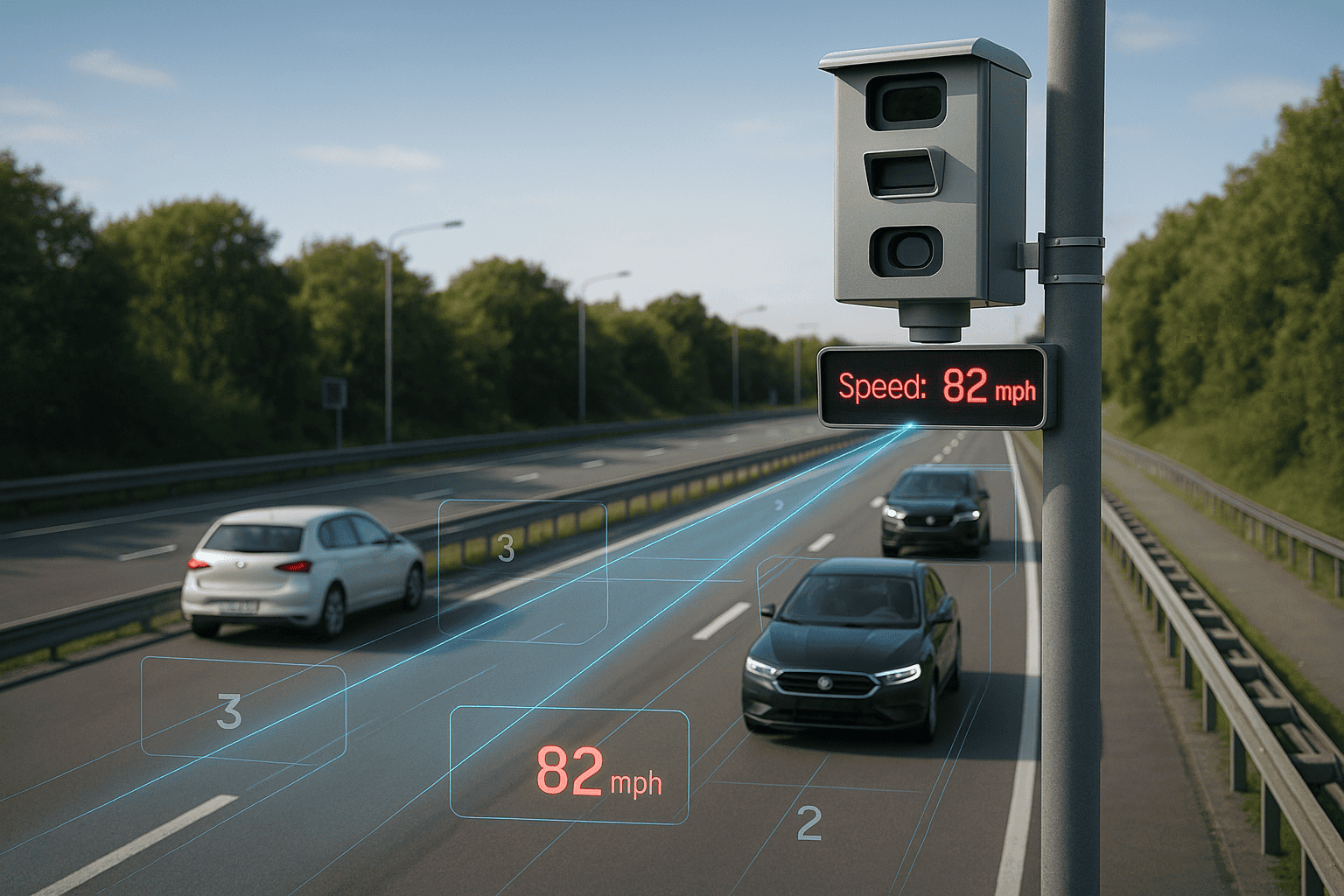
1. Lane-Specific Targeting
Modern radar and LIDAR systems segment the roadway into virtual lanes. Each lane is tracked independently. When a speed violation occurs:
- The system logs the lane ID.
- Cameras capture images and video focused on that lane.
- The license plate recognition system matches the correct vehicle.
This eliminates confusion between cars traveling side by side.
2. Image Correlation and Timestamping
Every speed reading is paired with:
- Exact timestamp
- GPS coordinates
- Vehicle image (front or rear)
- Lane data
The system cross-references this information to confirm the vehicle responsible. If two cars pass simultaneously, the one matching the radar signature (speed + lane) is tagged.
3. Multi-Target Tracking Software
Some high-end cameras use multi-object tracking algorithms:
- AI software analyzes each moving object in the frame.
- Each vehicle is assigned a unique ID.
- The system tracks their trajectory, speed, and distance over time.
This means even in heavy traffic, the camera knows exactly which car exceeded the limit.
4. Automatic Number Plate Recognition (ANPR)
Once a vehicle is flagged for speeding, the ANPR module:
- Reads the license plate using optical character recognition.
- Cross-verifies with traffic records or national databases.
- Attaches the plate number to the speed record.
This creates legally admissible evidence linking the speed violation to a specific car.
Types of Speed Cameras and Their Operation
1. Fixed Speed Cameras
Installed permanently on poles or gantries, these cameras monitor high-risk areas like:
- Intersections
- School zones
- Highways
They use radar or inductive loops to measure speed, and capture:
- Rear or front images
- Speed reading
- Location and time
Their systems are lane-calibrated, meaning they always know which car triggered the alert.
2. Average Speed (SPECS) Cameras
These systems monitor speed over a stretch of road, not just a single point.
- Two or more cameras record entry and exit times.
- ANPR identifies vehicles at each point.
- The system calculates average speed.
If the result exceeds the limit, the vehicle is flagged. This method eliminates “braking before camera” tactics and provides accurate tracking for each car individually.
3. Mobile Speed Camera Cars
Speed camera cars are vehicles equipped with radar or LIDAR units, used by law enforcement for flexible deployment.
They can:
- Park roadside or on overpasses.
- Scan traffic in real-time.
- Capture multiple vehicles simultaneously.
Each speeding detection is accompanied by:
- High-resolution image
- License plate
- Speed and distance data
Because LIDAR beams are narrow, the officer or automated system targets one vehicle at a time, ensuring precision.
4. Red-Light and Speed Enforcement Cameras
These hybrid systems enforce both signal violations and speeding at intersections.
- Inductive loops detect vehicle movement.
- If a car enters the intersection above a threshold speed after a red signal, it triggers image capture.
- Multiple photos prove both speed and signal violation.
Each event is tied to one vehicle through synchronized sensors and ANPR.
Accuracy and Error Prevention
1. Calibration and Certification
To maintain legal validity, all speed enforcement devices undergo:
- Routine calibration (daily, weekly, or monthly)
- Independent verification by authorities
- Certification logs stored for legal review
This ensures the recorded speed belongs to the correct car with minimal margin of error (typically <1%).
2. Secondary Checks
In some systems, a secondary method (like time-over-distance or image frame analysis) verifies the radar reading. This double-check prevents false positives.
3. AI-Based Validation
Modern cameras employ artificial intelligence to filter anomalies such as:
- Reflections from nearby vehicles
- Shadows or overlapping movement
- Lane change interference
AI ensures only the true violator is recorded.
How Evidence is Processed
Once a speeding event is confirmed:
-
Data packet is created with:
-
Speed value
-
Image evidence
-
Timestamp
-
Lane ID
-
Location
-
License plate
-
-
The event is transmitted to a central database.
-
Trained staff verify the data.
-
If valid, a notice of violation is issued to the registered owner.
This evidence is considered legally admissible, as it includes all necessary technical proof linking the offense to a specific vehicle.
Can Speed Cameras Get It Wrong?
While rare, errors can occur due to:
- Poor weather conditions (heavy rain, fog)
- Incorrect calibration
- Reflection from large vehicles
- Misaligned lane sensors
However, redundancy systems — like dual radar, frame analysis, and AI validation — make false readings extremely unlikely.
If a driver believes the reading is incorrect, they can request calibration records and image evidence as part of the dispute process.
Privacy and Data Protection
Speed camera systems are subject to strict regulations:
- Data is retained only for enforcement purposes.
- Non-offender data is automatically deleted.
- ANPR databases comply with data protection laws.
All images and readings are securely transmitted and encrypted to prevent tampering.
Future of Speed Camera Technology
The next generation of speed enforcement will include:
- AI-powered analytics for predictive traffic management
- 360° camera arrays capable of tracking every lane and object
- Integration with connected vehicles and smart city infrastructure
With advances in machine learning, cameras will soon not only detect speeding but also analyze driving behavior and automatically classify violations.
Frequently Asked Questions
1. Do speed cameras track every vehicle?
Yes. They continuously monitor all passing vehicles, but only record data when a violation is detected.
2. How do speed camera cars operate?
Speed camera cars use radar or LIDAR systems to measure speed. Each target is isolated and paired with photographic evidence, ensuring the right car is penalized.
3. Can multiple cars be caught at once?
Yes. In multi-lane systems, each lane is tracked separately. If several cars exceed the limit, each is recorded independently.
4. Do speed cameras record continuously?
Most operate in continuous mode but only store data for violations. Others record short bursts or snapshots when triggered.
5. Are speed readings admissible in court?
Yes, provided the camera is calibrated, certified, and evidence includes images, timestamps, and lane data.
By understanding how speed cameras combine radar precision, laser targeting, and AI-based image analysis, it becomes clear they rarely make mistakes. These systems are designed with accuracy and accountability in mind, ensuring that every speeding ticket is based on verified, evidence-backed data.